
Few ingredients are as deeply woven into Pakistani kitchens as desi ghee. It’s stirred into daal, spread on parathas, drizzled over rice, and used in everything from wedding sweets to everyday roti. But just like honey, ghee has become a target for adulteration — and knowing what “pure” actually looks like has never mattered more.
In this guide, we’ll cover what desi ghee actually is, its real health benefits, the adulteration problem in Pakistan’s ghee market, how to identify the real thing, and simple ways to use it every day.
What Exactly Is Desi Ghee?
Desi ghee is clarified butter made by slowly simmering butter (traditionally from cow or buffalo milk) until the water evaporates and the milk solids separate and lightly caramelise, leaving behind pure golden butterfat. This slow-cooking process is what gives ghee its deep, nutty aroma — something regular butter or vegetable oil simply doesn’t have. Unlike vanaspati (hydrogenated vegetable oil) or “banaspati ghee,” real desi ghee contains no added oils, colours, or preservatives.
Why Desi Ghee Still Has a Place in Modern Cooking
Ghee has a naturally high smoke point, which makes it well-suited to frying, tempering spices (tarka), and slow-cooked dishes without breaking down the way some vegetable oils do at high heat. It also carries fat-soluble vitamins A, D, E, and K, along with butyrate — a short-chain fatty acid that’s been studied for its role in supporting gut health. That said, ghee is calorie-dense, so it’s best enjoyed in moderation rather than as an unlimited health food.
The Adulteration Problem: Why “Ghee” Isn’t Always Ghee
Pure ghee takes time, quality milk, and careful cooking — which makes it more expensive to produce than mass-market cooking oils. This price gap has made ghee one of the more commonly adulterated food products in Pakistan, with some manufacturers cutting real ghee with cheaper vegetable oils, animal fats, or vanaspati to stretch volume and cut costs. Food safety authorities in Pakistan have periodically flagged and seized such adulterated batches from the market, underlining why sourcing matters as much as the label on the jar.
How to Identify Pure Desi Ghee
- Check the ingredient list. Pure ghee should only list “ghee” or “milk fat” — not vegetable oil, palm oil, or “vanaspati.”
- Look at the texture. Real ghee typically turns grainy or crystallised at room temperature in cooler weather, and fully liquifies without residue when gently heated.
- Smell it. Genuine ghee has a rich, nutty, slightly caramelised aroma. A flat, greasy, or overly neutral smell can be a red flag.
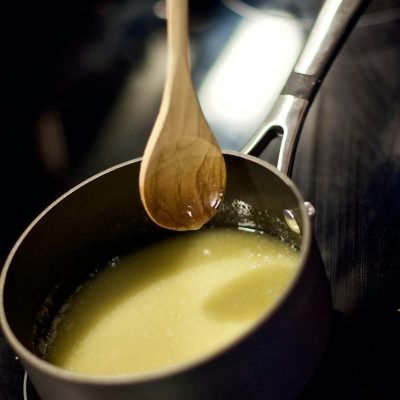
- Do a simple melt test. A small spoonful melted in a pan should turn a clear golden liquid quickly; if it takes a long time or leaves a waxy residue, it may be blended with other fats.
- Buy from transparent, traceable sources. Brands that are upfront about their sourcing and process are generally a safer bet than unmarked, loose ghee.
Everyday Ways to Use Desi Ghee
- A spoonful melted over daal, khichdi, or plain rice
- Brushed onto rotis and parathas straight off the tawa
- Used as the base fat for tarka (tempered spices) in curries
- Added to halwa, kheer, and other traditional sweets
- Mixed into warm milk as a traditional bedtime drink
- Used in place of butter or oil when roasting vegetables
Choose Organic, Traceable Ghee
At Kunn Organics, our KU – Organic Desi Ghee is made the traditional way, with nothing added and nothing hidden. If you’re building out a fuller organic kitchen staples collection, it pairs naturally with other pantry essentials like our Organic Mustard Oil, Extra Virgin Olive Oil, and Organic Coconut Oil — giving you a full, honest range of cooking fats for different dishes and needs.
Frequently Asked Questions
Is desi ghee healthier than cooking oil?
It depends on the oil and how it’s used. Ghee’s high smoke point makes it a stable option for frying and tempering, and it offers fat-soluble vitamins that some refined oils lack. Like any fat, though, it’s calorie-dense and best used in moderation as part of a balanced diet.
Why does my ghee sometimes look grainy?
Natural crystallisation, especially in cooler weather, is a normal sign of pure, minimally processed ghee — not a defect. It typically turns smooth and liquid again when gently warmed.
How long does desi ghee last?
Pure ghee has a long shelf life due to its low moisture content. Stored in a cool, dry place in a sealed, airtight container, it can stay fresh for several months without refrigeration, though refrigeration can extend this further in hot climates.
Can lactose-intolerant people eat ghee?
Ghee is almost entirely pure fat, with the milk solids (which contain lactose and casein) removed during the clarification process. Many people with mild lactose sensitivity tolerate ghee well, though those with severe dairy allergies should still consult a doctor first.
What’s the difference between desi ghee and regular butter?
Butter still contains water and milk solids, while ghee has had both removed through slow cooking. This gives ghee a longer shelf life, a higher smoke point, and a more concentrated, nutty flavour compared to butter.
Final Thoughts
Desi ghee has earned its place in Pakistani kitchens for good reason — but that trust only holds up if what’s inside the jar is the real thing. Knowing how to spot genuine ghee, and choosing brands that are transparent about sourcing, lets you enjoy its flavour and benefits without second-guessing every spoonful.